

For many software agencies, growth looks like more projects, more clients, and more development hours. But more work does not always lead to better work. Agencies that scale sustainably tend to attract a different type of client. They work with organizations that value clarity, product thinking, and long-term outcomes. UX is often the mechanism that creates that shift. When UX is integrated early into the engagement, agencies move beyond simply building software and begin helping clients shape better products.
The Hidden Problem With “More Work”

Many software agencies begin with a straightforward goal. Win more projects.
Early growth often comes from increasing the number of proposals sent, the number of features delivered, and the number of development hours billed. For a while, this works. The agency becomes busy, revenue increases, and the pipeline looks healthy.
Over time, however, a different pattern often appears. Projects begin to feel rushed. Requirements are unclear. Development teams spend more time clarifying decisions than building solutions. Clients arrive with ideas that are only partially formed, and expectations begin to shift midway through delivery.
At that point the agency is working harder, but the work itself becomes more complicated. Deadlines feel tighter. Revisions increase. Internal teams spend more time managing uncertainty.
This pattern is common across software development projects. Research from the Standish Group’s CHAOS Report has consistently shown that unclear requirements and shifting objectives are among the primary reasons software projects fail or exceed their budgets. When projects begin without sufficient problem validation, complexity tends to appear later in the process when it is much more expensive to address.
The issue is rarely the clients themselves. More often, it is how the project begins. And that starting point is usually where UX should be introduced.
The Agencies That Win the Best Clients Do One Thing Differently

The agencies that attract the most strategic clients rarely position themselves purely as development vendors. Instead, they position themselves as product partners.
This distinction changes how early conversations unfold. Instead of beginning with estimates and feature lists, the discussion starts with understanding the problem itself. Agencies ask questions about users, workflows, and friction points before discussing implementation.
- Who are the primary users?
- What are they trying to accomplish?
- Where does the current product experience break down?
When UX becomes part of the early conversation, the agency introduces a thinking phase before the building phase. That shift often changes how prospective clients respond.
Clients who value strategic input tend to engage more deeply in those conversations. Clients who are primarily looking for fast execution without reflection may lose interest.
Both outcomes are useful. The process naturally filters opportunities.
The importance of early problem framing is widely recognized in product development research. The Nielsen Norman Group has repeatedly shown that early user research and usability insights significantly improve product outcomes because they allow teams to identify structural issues before development begins.
UX Changes the Conversation From “Build This” to “Let’s Solve This”

When UX is absent from early discussions, agency conversations often follow a familiar pattern. A client arrives with a list of features and a desired timeline. The agency estimates the work and development begins.
Weeks later, questions surface. The features do not connect as expected. Users struggle with certain workflows. Stakeholders disagree about how the product should behave.
At this stage, the team is attempting to resolve product design decisions during development. That is one of the most expensive moments in the delivery lifecycle to introduce structural changes.
When discovery workshops, UX audits, or design sprints are introduced earlier, the conversation shifts toward product thinking rather than implementation. Teams explore user behavior, validate flows, and identify friction before engineering resources are fully committed.
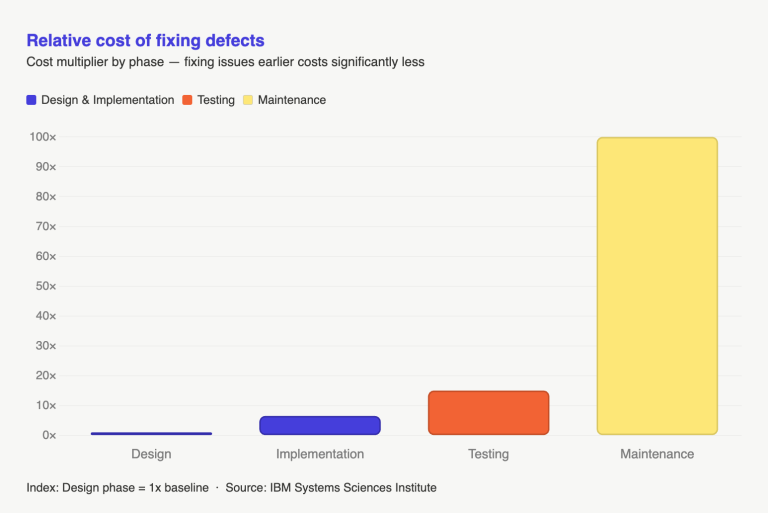
This early exploration significantly reduces risk. Research by IBM Systems Sciences Institute has historically demonstrated that the cost of fixing a problem discovered after release can be dramatically higher than fixing it during early design stages. Although exact numbers vary by study, the general principle remains consistent across software engineering research. Early validation reduces downstream cost.
In practice, this means agencies that prioritize UX spend more time clarifying the problem at the beginning so development can move forward with fewer surprises later.
UX Filters the Clients You Actually Want

One of the most overlooked advantages of introducing UX early is that it acts as a natural filter for client relationships.
When agencies propose structured discovery phases, some clients hesitate. Others become more engaged in the process.
The clients who hesitate are often looking for rapid implementation at the lowest possible cost. Their focus is typically on immediate delivery rather than long-term product quality.
The clients who lean into discovery tend to approach the product differently. They are thinking about user behavior, market positioning, and long-term product sustainability.
These clients are more likely to value strategic input and collaboration. They are also more likely to develop ongoing partnerships rather than one-time transactions.
Over time, that distinction shapes the agency’s entire client portfolio.
UX Makes Development Easier, Not Slower
There is a persistent misconception within some development teams that UX slows projects down. In reality, the opposite tends to be true when UX is integrated effectively.
Clearer flows and validated user journeys reduce ambiguity for engineers. Product decisions are resolved earlier. Stakeholder alignment happens before development sprints begin.
Instead of discovering structural issues halfway through implementation, teams address them when change is still relatively inexpensive.
Research by the Nielsen Norman Group and the Interaction Design Foundation consistently shows that usability testing and early user validation identify the majority of critical usability problems before development is finalized. Addressing those issues earlier allows teams to move through implementation with greater confidence.
The time invested in discovery frequently results in smoother development cycles and fewer revisions later.
UX Is Not Just a Service. It Is a Positioning Strategy.

Many agencies treat UX as one service among many. It appears alongside development, branding, or UI design within a services list.
However, the agencies that build the strongest reputations tend to treat UX differently. Instead of positioning it as an optional add-on, they integrate it into the foundation of their delivery model.
Discovery becomes the starting point of every engagement. Design becomes the shared language between product teams and engineering teams. Strategy becomes part of every conversation with clients.
Over time, this approach changes how the agency is perceived. The agency is no longer viewed as a group that executes specifications. It becomes a partner that helps shape better product decisions.
That perception shift has a direct impact on the types of projects and clients an agency attracts.
Why This Matters More Than Ever
Digital products are becoming more complex. User expectations continue to rise while development cycles accelerate.
In this environment, agencies that provide only development capacity often compete on price or speed. Agencies that provide clarity and product thinking compete on expertise.
UX enables that transition.
By helping clients understand their users and structure their products more effectively, agencies become collaborators rather than vendors. Collaboration is often what the most thoughtful clients are looking for.
Final Thought
Winning more clients is not the same as building a stronger agency.
Agencies that focus on UX early in the process often find themselves having better conversations with prospective clients. Those conversations lead to clearer projects, stronger partnerships, and products that perform better in the market.
Over time, that approach results in fewer chaotic projects and more meaningful work.
For many agencies, that is the kind of growth that matters most.