
Bringing in a UX partner can feel like adding another layer to an already complex delivery process. More coordination, more moving parts, and more potential for misalignment. In practice, the right UX partner does the opposite. Instead of slowing things down, it reduces friction by clarifying decisions earlier, aligning teams more effectively, and supporting development as it moves forward.
The Concern Most Teams Have
For many software agencies, the hesitation around introducing a UX partner is not about value. It is about impact on delivery. There is a natural concern that adding another role into the process will create more dependencies, more coordination overhead, and more moments where teams are waiting on each other. Developers worry about delays in decision-making. Project managers anticipate additional layers of communication. Stakeholders question whether timelines will stretch.
These concerns are valid, especially in environments where delivery is already under pressure.
What often goes unnoticed is that much of this friction already exists. It simply shows up later in the process in a different form. Clarification conversations happen mid-sprint. Decisions are revisited after development has started. Alignment issues surface when timelines are already tight. The question is not whether friction exists. It is where it is introduced in the process.
Integration Over Separation
The difference between added complexity and reduced friction comes down to how UX is integrated into the team.
When UX operates as a separate layer, producing deliverables in isolation and handing them off, it often creates gaps. Context is lost between teams. Developers are left interpreting intent. Project managers spend time reconnecting decisions across phases.
A more effective approach is integration. Instead of sitting outside the workflow, UX becomes part of it. The work happens alongside developers, project managers, and stakeholders, not before or after them. Conversations happen continuously, not just at handoff points. Decisions are shared in context, rather than passed along as outputs. This reduces the disconnect that often slows projects down.
Working Within the Tools Your Team Already Uses
Reducing friction often starts with not introducing unnecessary change. Rather than requiring teams to adopt new systems, UX collaboration happens within the tools already in place. Communication continues through Slack. Tasks and progress are tracked in ClickUp. Design work is created and reviewed in Figma, where flows and interactions can be understood in context. Decisions are shared through short Loom recordings or written summaries that can be accessed when needed.
In practice, this creates a connected, asynchronous workflow:
- Slack for ongoing communication and quick alignment
- ClickUp for task tracking and project visibility
- Figma for design exploration, flows, and prototypes
- Loom for explaining decisions and sharing context asynchronously
This setup does more than keep teams aligned. It creates a clearer path from design to implementation.
With modern tooling, the gap between design and code is becoming smaller. Well-structured Figma files, clear interaction logic, and documented flows allow developers to move into implementation with fewer assumptions. Tools that support code generation and AI-assisted development, such as Claude Code and similar systems, are making this transition even more direct. This means designers are no longer handing off static outputs. They are contributing to a system that is closer to build-ready from the start.
As a result, UX becomes more embedded in the development process. Instead of waiting for clarification, developers are working from a clearer, more complete foundation. Designers stay involved as decisions evolve, rather than stepping away after handoff.
This approach allows teams to stay aligned without relying on constant meetings. Developers can access clarity when they need it. Project managers can track decisions without chasing updates. Stakeholders can review direction without needing to be present in every discussion.
The goal is not to add structure for the sake of it, but to make the structure that already exists more effective and more connected to delivery.
Staying Ahead of Development
One of the most important ways UX supports delivery is by staying slightly ahead of development.
When UX is reactive, it responds to questions that arise during implementation. This creates pauses in the process, as developers wait for clarification on flows, edge cases, or interaction logic. Momentum slows as decisions are made under pressure.
When UX is integrated and proactive, those decisions are addressed earlier.
User flows are defined before they reach development. Edge cases are considered before they become blockers. Questions are resolved before they interrupt progress. Developers move into implementation with a clearer understanding of what needs to be built and why.
This creates a more consistent development rhythm, where progress is not interrupted by uncertainty.
How Our Team Shows Up Inside Yours

Integration is not just about tools or process. It is about how the team shows up.
At Pepperplane, we do not operate as an external design layer. We embed directly into the delivery environment, working alongside product, engineering, and project management as part of the same system. This means participating in the same conversations, understanding the same constraints, and contributing to decisions as they are being made.
Our team structure is designed to support this way of working. Each engagement includes a design lead who maintains direction, UX designers who develop flows and interactions, and alignment across project management and development. This ensures that thinking, execution, and coordination remain connected.
Rather than creating outputs in isolation, we stay close to the flow of the project. Decisions are clarified early. Questions are addressed as they emerge. Context is shared continuously rather than reconstructed later.
Over time, this changes how the team operates. UX is no longer something that happens alongside development. It becomes part of how development moves forward.
Removing Friction Instead of Adding Process
The idea that UX adds process often comes from experiences where design is layered onto delivery rather than integrated into it. When UX is introduced late, it can feel like an additional step. More reviews, more revisions, more back and forth. When UX is embedded early and works alongside the team, the experience is different.
Developers spend less time interpreting requirements. Project managers spend less time resolving uncertainty. Stakeholders spend less time reacting to unexpected outcomes. The number of interruptions decreases because many of the underlying questions have already been addressed earlier in the process.
The system becomes more stable, not more complex. We do not add processes. We remove friction.
What This Looks Like in Practice
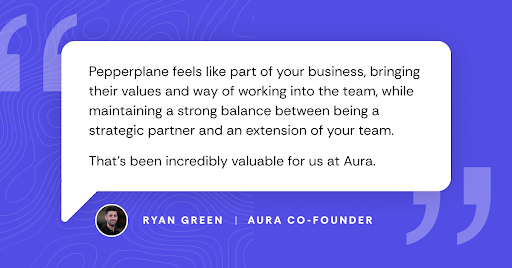
In a recent collaboration with Aura, the team was moving quickly toward building out complex operational workflows. Like many fast-moving product teams, development pressure was high, and decisions needed to be made quickly.
Instead of working as a separate design layer, UX was integrated directly into the process. The focus was not just on producing screens, but on aligning product, design, and development early around how the system should behave.
This meant clarifying workflows before they reached development, identifying gaps in requirements early, and making decisions while change was still relatively inexpensive. Rather than waiting for questions to surface mid-sprint, many of those questions were addressed in advance.
As a result, development became more predictable. The team spent less time revisiting decisions and more time moving forward with confidence. Alignment improved across stakeholders, and the overall delivery process felt smoother, even as the product itself became more complex.
This is where integration becomes less about coordination and more about shared ownership of the outcome.
Final Thought
Bringing in a UX partner should not make delivery feel heavier.
When integration is done well, teams move with greater clarity, fewer interruptions, and more confidence in the direction they are building toward. The goal is not to add process. It is to remove the friction that slows everything else down.
If you are exploring how UX could fit into your workflow, a good starting point is understanding how this looks in practice. You can take a look at some of the teams we have worked with here.
If it feels aligned, we are always open to a conversation. You can book a discovery session and we can take a closer look at how this might fit into your current process.