
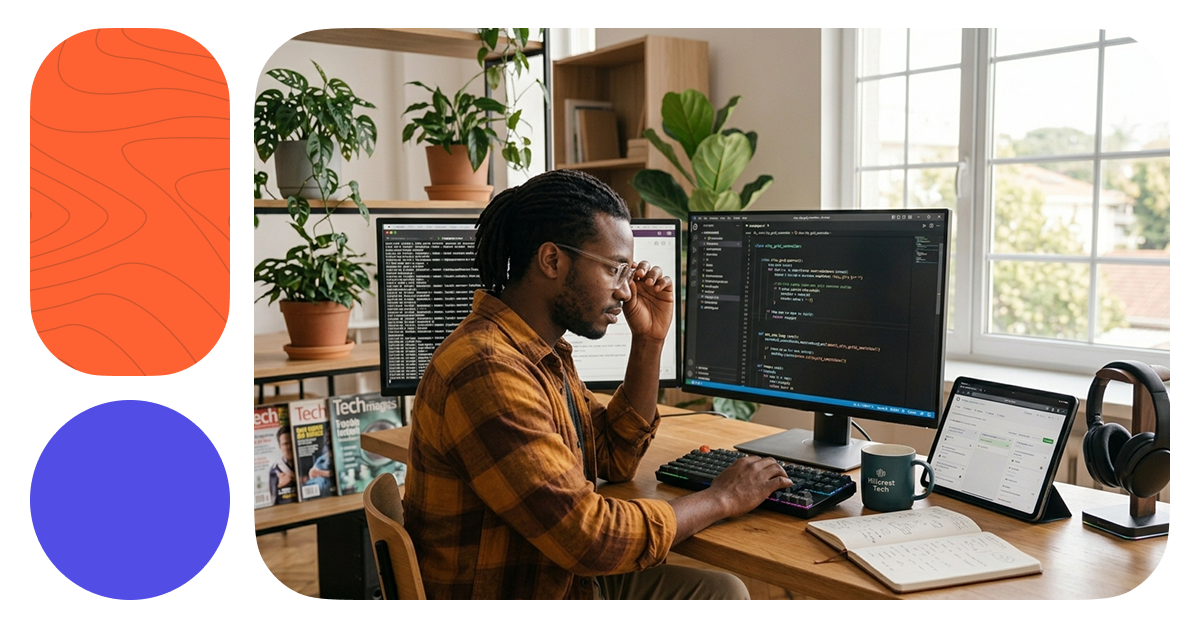
Why Better Products Come From Collaboration, Not Rigid Handoffs
The best designer-developer relationships don’t begin when the Figma file is finished. Developers bring technical context, questions, and perspectives that can uncover gaps in a user experience long before anything ships. When design and development collaborate throughout the process, technical constraints become opportunities to find better solutions, unclear interactions get resolved earlier, and both teams gain greater confidence in what they’re building.
There’s an old version of the design process that goes something like this: designers design, developers build, and somewhere in between sits a handoff where everyone hopes the Figma file contains enough information to answer every possible question.
Real product development is rarely that tidy.
A design can look completely resolved on the screen and still raise important questions once a developer begins thinking about how it will actually work. What happens when the data isn’t available? What if the user doesn’t have permission to perform this action? How should this behave when the response takes longer than expected? What happens when someone enters the flow from somewhere we hadn’t considered?
Those aren’t simply implementation questions. Very often, they’re UX questions too.
That’s why we don’t think developer feedback belongs at the end of the design process. Developers bring a perspective that can make the experience stronger while there’s still time to shape it.
“Good UX isn’t designers handing developers finished screens and disappearing.”
A Design Can Look Finished and Still Have Questions
There is a big difference between designing how something should work and seeing what it takes to make that behavior real.
In Figma, we can demonstrate the ideal path through an experience. We can show how someone moves from one step to another and document the states we’ve anticipated. But once developers begin looking at the design through the lens of the actual system, they often uncover scenarios that deserve another conversation.
Maybe a piece of information the interface relies on isn’t always available. Perhaps a process happens asynchronously, which means the experience needs to account for waiting or failure. An interaction might work well for the primary use case but become confusing when permissions, account types, or existing data change.
These questions don’t mean the design was poorly considered. They reflect the fact that designers and developers naturally see different parts of the same problem.
When those perspectives come together early, the product benefits from both.
Technical Constraints Can Lead to Better Design
“Technical constraint” can sound like something designers would rather not hear.
But constraints aren’t automatically bad for UX. Sometimes understanding how the system actually works leads us toward a simpler and more appropriate solution.
A proposed interaction might require significant technical complexity for relatively little user benefit. Once we understand that, we can ask whether there’s another way to achieve the same outcome. In other situations, a developer may explain that something we assumed would be difficult is actually straightforward, opening up possibilities we hadn’t explored.
The point isn’t that technical limitations should dictate the user experience. It’s that technical reality is part of the context we’re designing within.
The strongest solution is often the one that balances user needs, business goals, and implementation realities rather than optimizing for one of those things in isolation.
Developer Questions Can Expose UX Gaps
Some of the most useful feedback from developers comes in the form of a very practical question.
“What happens if this fails?”
“Can the user come back to this later?”
“What do we show while this is loading?”
“What happens if there aren’t any results?”
“Can someone reach this screen without completing the previous step?”
Questions like these can expose gaps that weren’t obvious while designing the primary flow. They force us to think beyond the ideal scenario and consider what the experience feels like when real life gets involved.
Those conversations are especially valuable because users don’t experience products as a collection of perfect happy paths. Connections fail. Information is missing. People make mistakes. Permissions change. Someone closes the browser halfway through a process and returns three days later.
When a developer question uncovers one of those scenarios before the feature ships, that’s not development slowing design down.
That’s the team making the product better.
Sometimes the Design Needs to Change
There can be a temptation to treat approved designs as finished.
Once stakeholders have reviewed them and the screens are ready for development, changing something can feel like moving backward. But if new information reveals a better solution, protecting the original design simply because it has been approved doesn’t help anyone.
Sometimes the change is small. We add a missing state, clarify an interaction, or adjust what happens after an action. Other times, a technical conversation reveals that part of the workflow needs to be reconsidered more substantially.
What matters is why the design changes.
We’re not revising the experience because development “couldn’t build what design wanted.” We’re responding to a clearer understanding of how the product needs to work. That distinction turns what could feel like friction between disciplines into collaborative problem-solving.
The Best Solution Usually Comes From the Conversation
When designers and developers collaborate well, the conversation isn’t about one discipline handing the problem to the other.
It’s more like, “Here’s what the user needs. Here’s what we’re trying to accomplish. Here’s what the system can currently do. How do we solve this together?”
That creates much more room for good ideas.
The designer brings context about users, workflows, and the intent behind the experience. The developer brings knowledge about system behavior, architecture, dependencies, and implementation possibilities. Product and stakeholders may bring additional business context.
No single perspective contains the whole answer.
The solution gets stronger when everyone has enough context to contribute rather than simply being asked to execute their portion of the work.
Why Rigid Handoffs Create Unnecessary Friction
A handoff is useful. Developers need clear designs, documented behavior, states, components, and enough context to implement the experience confidently.
The problem comes when the handoff becomes a wall.
If design disappears after delivering the Figma file, developers are left interpreting unanswered questions themselves. They may have to make UX decisions without the context behind the original design, or implementation pauses while everyone tries to reconstruct conversations that happened weeks earlier.
Neither outcome is particularly efficient.
We’d rather think of handoff as a point in an ongoing collaboration. The designs should provide clarity, but the conversation should remain open. Questions will appear during development because software is complicated, and sometimes those questions will reveal something worth changing.
That’s normal.
The goal isn’t to create a design so perfect that nobody ever needs to speak again. It’s to create enough shared understanding that when questions do appear, the team can solve them quickly and thoughtfully.
What This Looks Like at Pepperplane
At Pepperplane, we work closely with developers because we see implementation as part of the product experience, not something that happens after UX is finished.
That means conversations can happen before formal handoff, while features and workflows are still being shaped. Developers can raise technical considerations early, and designers can provide context around why particular decisions were made. Once development begins, that collaboration continues through reviews, Figma comments, Slack conversations, and whatever communication makes sense for the team.
Sometimes development confirms that the design works exactly as expected. Sometimes a question reveals an edge case we need to address. Occasionally, the conversation produces a solution neither side would have reached independently.
Those are often some of our favorite moments because they reinforce something we’ve seen repeatedly: good products don’t emerge from disciplines working beside each other.
They emerge from people solving problems together.
Final Thought
A polished interface can show that a project reached the finish line, but it can’t tell you everything that changed along the way. The more meaningful story might be that someone can now complete a task without stopping to figure out what to do next. It might be that a complicated workflow became simpler, developers have clearer patterns to build from, or the product team finally has enough clarity to make the next decision with confidence.
Those changes may not fit neatly into a final mockup, but they’re often the reason the work mattered in the first place. A case study shouldn’t end with the final screens. It should end with what changed because of the work.
Ready to Build Better Products Together?
Looking for a UX partner who can bring clarity to your next project? We’d love to chat.
Book a discovery call and let’s build something remarkable together.